By: Denko Rafajlovski, Renewable Energy ManagerNational Electricity Market Operator – MEMO The energy transition is...
A panel discussion was held at the Faculty of Electrical Engineering and Information Technologies (FEIT), organized by the “Association of Energy Engineers – ZEMAK”, on the topic “Experiences and challenges from the introduction of the Carbon Border Adjustment Mechanism – CBAM”, dedicated to the effects of its implementation from 1 January this year.
The event brought together representatives from MEPSO, MEMO, MAKSTIL, the Ministry of Energy, Mining and Mineral Resources, and the Customs Administration.
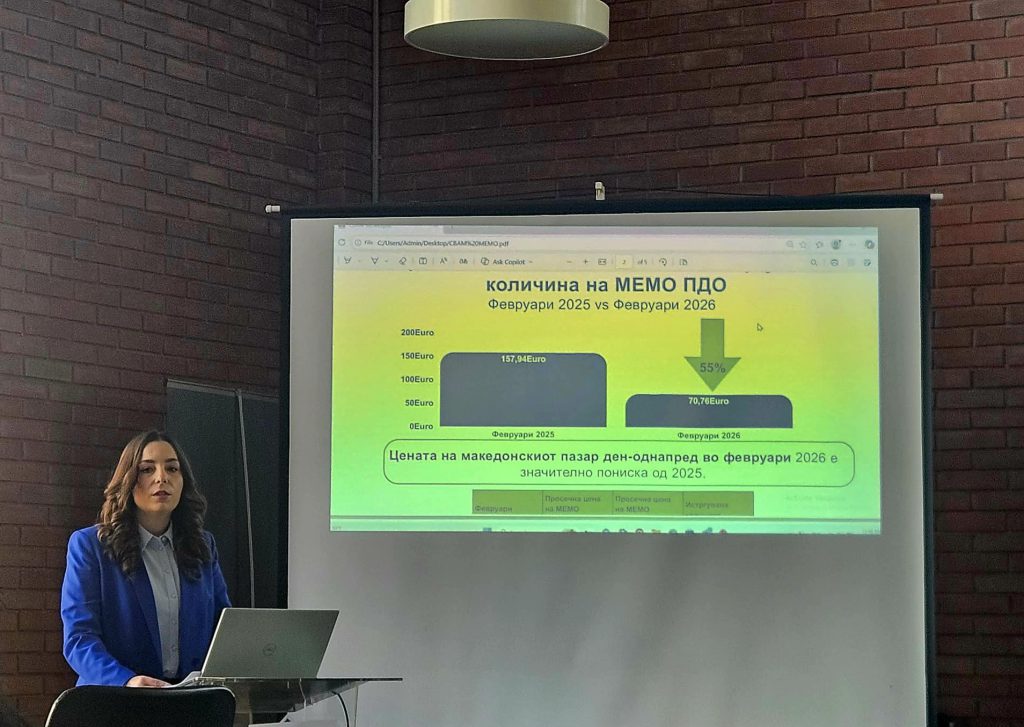
Within the panel discussion, Ana Angelova, Market Operations Expert at the National Electricity Market Operator – MEMO LLC, Skopje, delivered a presentation titled “Experiences and challenges from the introduction of CBAM.” In her presentation, she addressed the impact of this mechanism on the electricity market in North Macedonia and across the region, as well as the role of Guarantees of Origin and their potential to mitigate the mechanism’s effects.
Angelova noted that the electricity market is one of the sectors where the effects of the introduction of CBAM are already beginning to be felt. Although the mechanism is still in an early stage, the initial indicators, as she emphasised, show that it has the potential to significantly influence regional electricity markets.

“We analysed the achieved prices on the day-ahead market in comparison with several markets – Hungary, Serbia, Bulgaria and Greece. In February 2025, the price on the Macedonian day-ahead market was approximately at the same level as the prices on the analysed markets. However, in February 2026, significant price differences can be observed. The average price in North Macedonia was EUR 42.3 per MWh, lower than the price on the Hungarian power exchange HUPX. The average price achieved on the Macedonian day-ahead market is the lowest compared to the average prices on the analysed European markets, while the price curve in February 2026 is most similar to the one observed on the Serbian day-ahead market,” Angelova pointed out.
She added that such price differences create additional pressure on the margins of companies investing in renewable energy sources and represent a clear signal that swift and coordinated measures are needed. Similar trends, according to her, can also be observed in the region – in Serbia and Montenegro, while Albania is in a somewhat more favourable position due to its hydropower potential.
“At the moment, electricity generation from renewable sources does not allow for sufficient exports to neighbouring EU Member States, which makes this electricity less competitive compared to electricity produced on European markets. This issue may become even more pronounced during the spring months, when renewable generation, especially from solar energy, reaches its peak while consumption decreases. In such circumstances, part of the generated electricity cannot be fully utilised, exported outside the country or stored due to limited battery storage capacities,” Angelova explained.
She stressed that although CBAM is designed as a mechanism to protect European industry and encourage decarbonisation, its indirect effects are already being felt in EU Member States as well.

“These effects are manifested through larger price differences between markets, increased physical electricity flows between the power systems of EU Member States, as well as reduced cross-border electricity trade between the EU and countries outside the Union,” Angelova said.
At the same time, she pointed out that the European Union has already prepared amendments aimed at facilitating this mechanism, which are expected to be adopted by the end of the year in order to ensure a fairer transition for countries that are in the process of alignment.
Angelova also emphasised that currently, there is no clear mechanism through which CBAM can be calculated or applied to electricity traded through the market coupling process.
In this context, she highlighted that MEMO has an initiative for coupling the Macedonian organised electricity market with the European market. This process would contribute to higher market liquidity, closer alignment of domestic prices with those in the European Union, and increased competitiveness of electricity produced in North Macedonia.
“An important alternative for our companies is also export through Power Purchase Agreements (PPAs), which, although still somewhat unclear in terms of their practical application, represent a potential mechanism that could enable the direct export of clean energy and serve as a key tool for maintaining competitiveness,” Angelova added.
She also emphasised that Guarantees of Origin represent an important instrument for increasing the value of green electricity.
“In 2025, MEMO successfully established a system for Guarantees of Origin aligned with European standards and has already become an associate member of AIB – the Association of Issuing Bodies, which is an important step towards the full recognition of Macedonian Guarantees of Origin on the European market,” Angelova stated, adding that work is also underway towards MEMO’s full membership in AIB, as one of the steps towards recognition of Guarantees of Origin within EU countries.
Although Guarantees of Origin themselves do not provide direct exemption from CBAM, in combination with market coupling processes and new market mechanisms, they can significantly contribute to improving the competitiveness of green electricity from North Macedonia.
Additionally, as highlighted during the discussion, MEMO will launch a new market segment in May this year – the Intraday Electricity Market, which will contribute to more efficient management of electricity generation and consumption.