
By: Denko Rafajlovski, Renewable Energy ManagerNational Electricity Market Operator – MEMO The energy transition is...
Written by: Aleksandar Ristovski, Head of Electricity Market Management Department
National Electricity Market Operator-Memo LLC SKOPJE
The Need to Balance the Power Supply System
The balance between electricity generation and consumption is an essential prerequisite for the stable functioning of the power supply system (PSS). Any deviation in power causes a change in frequency and deviation from its nominal value.
These disruptions negatively affect consumers and generators and can lead to outages, creating even greater imbalances and system-wide dysfunction.
• Deviations in the grid occur due to:
• Production unit, line or consumer outage,
•Deviations of consumption or generation from planned values (forecasting errors),
• Rapid fluctuations in consumption or generation.
Frequency Regulation Mechanisms
Different frequency regulation mechanisms are introduced along with the development of the PSS. They allow increasing or decreasing the power of generating units or consumers in order to reestablish system balance and stabilize the frequency at its nominal value.
To this end, there are:
• Generating capacities that can respond by increasing or decreasing the power,
• Consumers who can adjust their consumption according to the needs of the system.
Electricity Balancing Market
In conditions of a liberalized electricity market, MEPSO holds the responsibility for maintaining the frequency as a transmission system operator (TSO). Since it does not have its own production facilities, MEPSO procures the regulation services from power generation units or consumers that meet the technical criteria. In this way, markets of different types of reserves and balancing energy are formed, where the only buyer is the TSO. Regional integration of these markets is a prerequisite for creating a single European market for frequency regulation services.
Market Balancing Resources
• Generation management – gas turbines and rapid response hydropower plants.
• Consumption management – automated systems and incentives for changing consumption.
• Energy storage – batteries and other systems that absorb or deliver energy as needed.
Challenges in Balancing
Several factors make it difficult to balance the system:
• Integration of renewable energy sources – volatility and unpredictability of wind and solar energy.
• Consumption variability – unpredictable load volume, which requires precise prognosis and quick reactions.
• Network disruption – limited transmission capacity that makes it difficult to transfer resources between regions.
The role of MEMO DOOEL Skopje
Since 2008, MEMO DOOEL Skopje, as the Electricity Market Operator, has been responsible for:
• Calculation of the differences between the planned and actual amount of electricity,
• Application of the balancing mechanism described in the Rules for balancing the electricity system (and in the future in the new Rules for registration on the market),
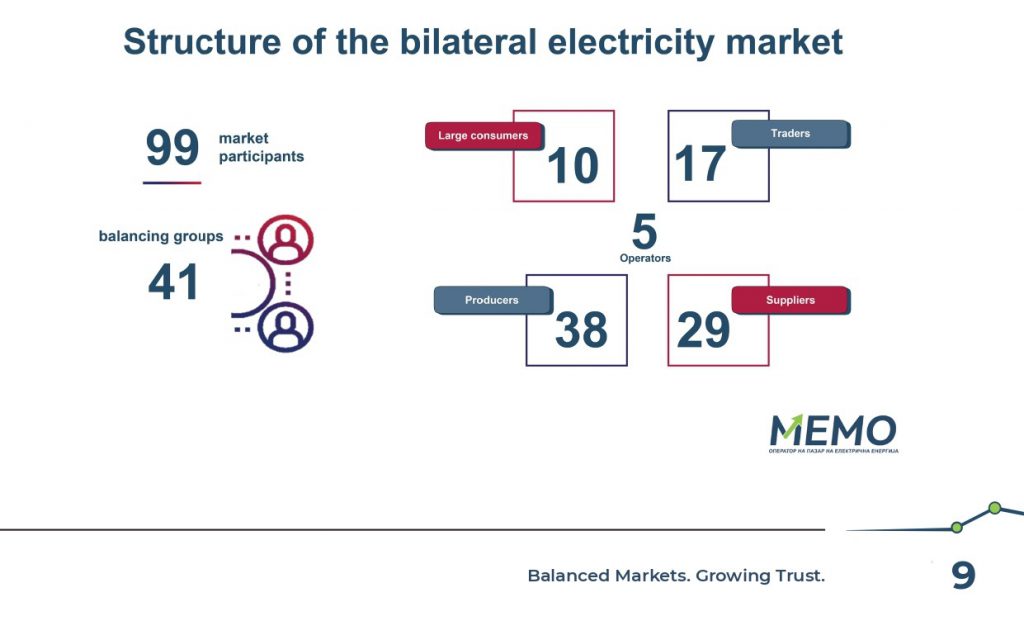
• Grouping of participants into balanced groups represented by balanced responsible parties,
• Calculation of deviations based on planned and measured quantities.
Financial Settlement
• For each hour, settlement prices obtained on the balancing energy market are applied.
• MEMO uses a specialized software package to run balance groups and calculate settlements.
• The financial settlement is carried out by MEPSO AD Skopje, which distributes the funds to the providers of balancing services.
Conclusion
In the country, balancing the grid is the basis for a reliable and stable electricity supply. The integration of renewable sources, the dynamics of electricity consumption, and the limitations of the transmission network all impose the need for modern mechanisms and efficient coordination among all market participants. MEPSO and MEMO, through their competencies, have a key role in maintaining balance and financial stability in the system, and regional integration will contribute to greater competitiveness, efficiency, and security of electricity supply.